
The DfE’s Writing Framework, published back in July, shone a much-needed spotlight on sentence mastery, as a cornerstone of writing success. It recommended that: ‘Sentence-level teaching, which focuses on pupils’ understanding about how to construct sentences, should be a key component of any writing curriculum.’
However, what the Framework didn’t tell us is what should be taught, or when. Recognising schools needed more support, we shared our Ark Sentence Mastery Sequence, making it available to all to download – for free.
Developed for use in Ark Schools, by the teams behind English Mastery Primary, English Mastery Secondary and Ark Start, this evidence-informed progression sequence shows how sentence knowledge and skills can be taught progressively, explicitly and effectively from Reception through to Year 7.
In this blog, Sarah Spink, Head of Primary English at Ark Curriculum Plus explains how using a clear, cumulative approach to sentence-level instruction can empower your teachers and unlock real writing progress for your pupils.
Why Sentence Fluency is a Game Changer
In 2025, Key Stage 2 writing attainment was the lowest of all subjects, and has been since 2022. The writing struggle is real. Writing skill is a predictor of academic success: by not meeting the expected standard in English, pupils are effectively disenfranchised across all subjects at Key Stage 3 and will need additional support to catch up. However, interventions won’t address the root cause of writing underachievement – namely, the gradual accumulation of sentence dysfluency over time.
In my experience, most primary schools provide direct instruction in vocabulary, transcription (handwriting and spelling), and the conventions of grammar and punctuation. But long overlooked is the humble sentence.
The only way we can truly address writing underachievement is by tackling it early to prevent bad habits forming, from the very beginning of a child’s writing journey. This involves direct instruction in syntax. Sentence fluency is the game changer, which will lead to improved writing outcomes at Key Stage 2 and better prepare pupils for the demands of secondary education and beyond.
First, it’s important to recognise that writing is really, REALLY hard.
‘Writing is the cognitive equivalent of digging ditches.’
Kellogg, R. (1994) ‘The Psychology of Writing’ Oxford University Press
Writing is the most cognitively demanding task that we expect pupils to master at primary school. Within the writing process, an excessive number of individual components must work in unison for writing to be successful.
Word & Sentence Level Writing Processes
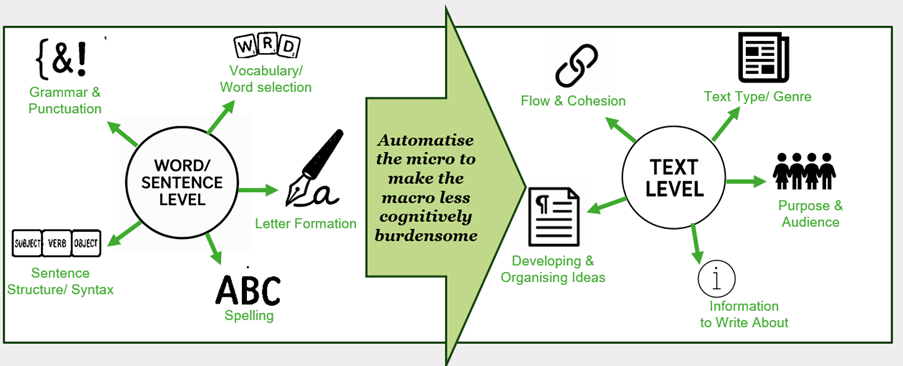
At the micro level, effective writing relies on pupils coordinating multiple processes.

Pupils must select appropriate vocabulary from a sufficiently broad lexicon and transcribe it through secure letter formation and pencil control. Spelling demands knowledge of phoneme–grapheme correspondence, exception words, and spelling patterns. Words must be arranged into syntactically coherent sentences, requiring an understanding of sentence structure. Finally, grammar and punctuation must be applied to ensure accuracy and clarity.
Text Level Writing Processes
Next, zooming out to the macro level, effective writing requires pupils to coordinate a range of higher-order processes.
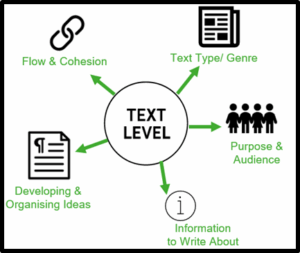
Pupils must understand the features of different genres, their purposes, and be able to adapt their tone and formality to suit the audience. They must draw on sufficient subject knowledge to generate content, as without this composition is severely limited. This content must then be developed and organised into a logical structure, with cohesion within and across paragraphs to guide the reader and ensure clarity.
In order to write effectively, pupils have to think about all of these things – at the word and sentence level and the text level – all at once!
‘Learning is hampered when working memory capacity is exceeded.’
De Jong, T. (2010) ‘Cognitive load theory, educational research, and instructional design: Some food for thought’. Instructional Science
Juggling all these components – at the same time – means that pupils’ working memory capacity is exceeded continuously. As a result, pupils struggle to write confidently, exhibit poor grammatical knowledge application, and are prone to making basic errors.
We need to get writing right.
So how do we do this?
If pupils acquire automaticity in the fundamental micro writing processes, before tackling composition, just think how much more easily they will meet the demands of the National Curriculum (and meet them first time, without excessive redrafting!).
The ultimate aim is to automatise the micro processes, to make the macro less cognitively burdensome.
The best practice I have seen in schools is where they prioritise explicit instruction of syntax. Schools like Ark Victoria Academy in Birmingham, and Stanley Road Primary School in Oldham, do this well. For others, it is the missing piece.
Sentence fluency is the game changer.
To help schools prioritise syntax, we developed the Ark Sentence Mastery Sequence that prioritises sentence fluency. We often talk about fluency in reading, but it applies just as much to writing.
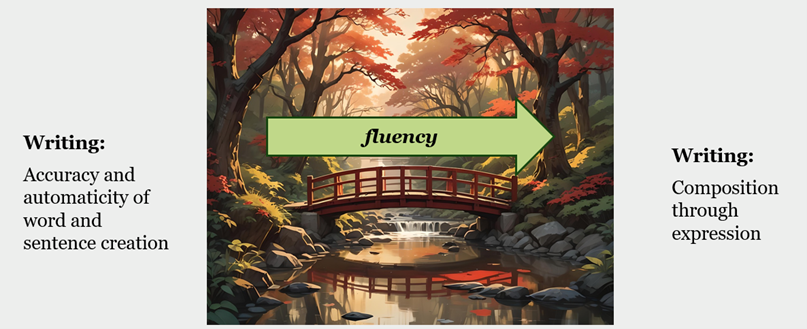
In writing, fluency serves as a bridge between word and sentence creation and composition.
Because fluent writers are able to form words and sentences accurately and automatically, the amount they’re holding in working memory is reduced and they can focus most of their attention on expressing meaning.
If pupils struggle with fluency in sentence generation, they’ll struggle with composition. Yet fluent writers can create sentences, and express meaning, at the same time.
In order to fix the writing struggle, we must intentionally teach pupils to unlock the mysteries of the sentence and to master its art. Explicit sentence instruction is essential. A curriculum that prioritises sentence fluency is not simply focused on mechanics; it lays the groundwork for creativity. When the technical becomes automatic, the writer is freed to focus on expression.
But teaching the art of the sentence is no easy feat! In order to teach syntax effectively, teachers need a clear and cumulative sequence to follow, containing the knowledge and skills pupils need to craft accurate, fluent and well-controlled sentences, year on year.
This is where our Ark Sentence Mastery Sequence can help. By making sentence construction teachable, visible and systematic, the Sequence aims to build confident, fluent, and accurate writers – sentence by sentence.
If you want to find out more about the research principles that underpin the Ark Sentence Mastery Sequence, as well as how you can best use it in your schools, come along to our free webinar. Register for your free place.
Looking for more support with your English curriculum?
English Mastery Primary is a complete reading, writing and grammar programme for Key Stage 2, connected by a reading spine of incredible books.



Get in touch
Let us know you’re interested by completing this form. Our team will be in touch to arrange an informal meeting to discuss your school’s needs.