The subject excellence programmes include purposeful, integrated assessments at every point to give teachers accurate and actionable insights, showing a true picture of what each child has understood and how to support their progression. They’re designed to minimise the burden on the teacher and the student.
Designed to be accurate
- Our assessments are all curriculum aligned, as a fundamental starting point. Whether they’re within a lesson, unit, term or year, they’re always only testing things that have already been taught.
- Termly and annual assessments are fully benchmarked so that schools can reliably interpret the results and compare performance against hundreds of schools in our network. Annual summative assessments are benchmarked against a nationally representative sample of schools to provide reliable grade boundaries schools can trust.
- Annual assessments at secondary are unseen, supported by careful question banking where appropriate. This is because it is well documented that if the questions don’t change, results on those questions will artificially improve year on year.
- We use sophisticated analytics to understand validity and reliability and keep improving our questions.
- We support teachers to accurately mark assessments and offer standardisation training and Assessing for Mastery CPD sessions. In English secondary, we guide teachers to confidently use comparative judgement via standardisation guidance and live CPD.
Designed to be actionable
- Assessments support responsive teaching by being linked directly to learning objectives. Teachers gain a precise view before, during, and after lessons of what students know, so that they can support progression for every child.
- They are based on a clear purpose at each assessment point, on a spectrum:
-
- More formative question design with stronger diagnostic power: measure specific skills or knowledge to give teachers information about how to develop students further in subsequent lessons.
-
- More summative question design with stronger predictive power: test composite skills or knowledge to give teachers an accurate account of how students are likely to perform in an exam context.
- We provide clear data analytics to support teacher and leader decision making. We deliver CPD sessions on understanding the primary purpose of the data and what valid inferences can be drawn from it.
- We identify topics where assessments show the weakest teaching and learning, then connect teachers to targeted CPD to make improvements.
- Assessments are inclusive. Tasks are accessible to students from different backgrounds and attainment levels, and they avoid cultural or linguistic bias. This gives students equal opportunity to demonstrate their understanding.
- Our assessments boost memory, with built-in retrieval practice.
- We make sure they’re low stakes, where possible.
Formative or summative?
AC+ assessments are always designed with a clear purpose. They are rarely purely formative or purely summative. Instead, they sit on a spectrum – different inferences can validly be drawn in each case.
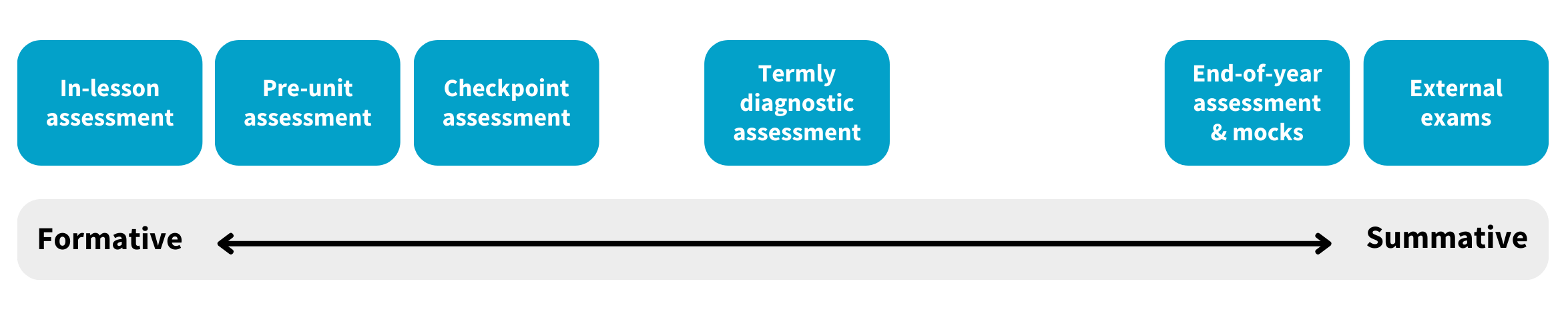
Our more formative assessments are designed to establish ‘knowledge gaps’ and identify misconceptions. They inform adaptations to medium term plans, planning of reteach and interventions. In our more formative assessments:
- Each task has a very narrow focus, breaking down complex skills and isolating the constituent parts.
- Tasks are granular enough to quickly and precisely identify students’ strengths and weaknesses.
- Tasks are focused on the important residual knowledge that all students must remember.
- Multiple-choice questions are often used to easily highlight misconceptions.
- Each assessment can only sample the domain and as such the most important concepts that every student must master are selected.
Our more summative assessments instead give a measurable snapshot of cumulative attainment of knowledge and understanding in a subject at a given point in time. They enable comparisons of student attainment within and across schools to quantify their progress over time and their position within a cohort. In our more summative assessments:
- Tasks are often multi-faceted or more open, requiring students to bring together their knowledge from across the subject domain.
- Each assessment can only ever sample the domain.
All our summative assessments are fully benchmarked, and at secondary they are unseen.
Read more about the purpose of each type of assessment within the AC+ programmes:
Explore the principles behind our programmes
Case studies

75% of students now take GCSE Geography at Ark Pioneer Academy

“Transformative”: Ark Curriculum Plus impact within St Joseph Catholic Multi Academy Trust