
Three practical levers for school and trust leaders during the National Year of Reading
By Sarah Spink, Head of Primary English, Ark Curriculum Plus
As school and trust leaders reflect on World Book Day celebrations across their schools, many will have seen classrooms celebrating books and promoting reading for pleasure.
These moments matter because they build a culture where books are valued and reading is visible across the school.
But culture alone is not enough.
Alongside promoting reading for pleasure, leaders must also ask a more fundamental question: are pupils developing the reading fluency they need to read confidently and independently?
Pupils who struggle to read fluently often struggle to read for pleasure. When reading is slow and effortful, it becomes harder to sustain attention, follow meaning or choose to read independently.

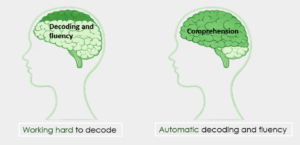
If pupils aren’t developing the reading fluency they need, the consequences ripple across their learning: progress stalls, attainment gaps widen, and some learners – including those with SEND – risk being left behind.
During the National Year of Reading, this makes it an urgent leadership question: is fluency explicitly taught in your school, or quietly assumed?
Across the schools I work with, one pattern is clear:
- Where reading fluency is deliberately taught, comprehension improves rapidly.
- Where it is left to chance, progress stalls.
Fluency: A Definition
For leaders reviewing reading provision, it is helpful to begin with a clear definition.

Accuracy, automaticity and expression (or prosody) are widely recognised as the three dimensions of fluency:
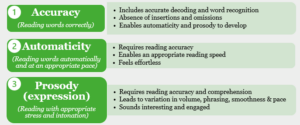
If fluency is weak, understanding is fragile. When it is secure, comprehension strengthens and pupils are far more likely to read independently and widely for pleasure.
Fluency Is Not Fixed
Fluency is not a trait some pupils “have” and others “lack”. It improves with deliberate, structured practice.
For pupils to develop accuracy, automaticity and expression, they need regular opportunities to:
- Practise reading difficult words before encountering them in the text
- Read sections of text more than once (repeated reading)
- Hear a model of fluent reading and be taught how to emulate it
In Ark schools, we codify this through our Reading Signature Strategies: practical routines embedded within whole-class reading lessons to build fluency systematically.
For leaders looking to strengthen reading provision, these translate into three practical actions:
1. Practise reading difficult words before encountering them in the text
Fluent reading improves when teachers remove barriers in advance.
Effective lesson design identifies in advance:
- Unfamiliar or complex vocabulary
- Less common grapheme–phoneme correspondences
- Morphological patterns that may cause hesitation
These are then rehearsed explicitly before reading begins. This preparation reduces cognitive effort during reading and allows pupils to focus their attention on meaning.
What does this look like in practice?
In English Mastery lessons, teachers draw attention to tricky graphemes, syllabification and morphology (roots, prefixes and suffixes) through annotation of the text:
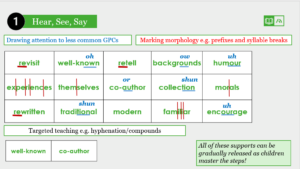
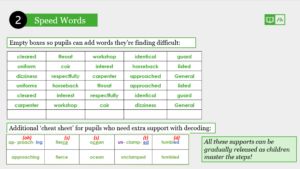
Then we build accuracy and automaticity of word recognition through repeated reading of these challenging words, with the aim for the words to be read ‘at a glance’.
‘Tricky’ words from a text pupils are about to read are placed in a ‘Speed Words’ grid, for isolated, timed rehearsal:
Leadership prompts:
- Expect lesson plans to flag likely decoding challenges
- Build time for pre-teaching and rehearsal
- Monitor that this approach is consistent across year groups
2. Read sections of text more than once (repeated reading)
Automaticity develops through repeated, structured practice.
However, in many classrooms pupils read a passage once, answer questions and move on – limiting fluency growth.
More effective practice includes:
- Short sections re-read with focus
- Partner reading to ensure every pupil reads aloud
- Immediate, precise feedback
The goal is not speed for its own sake. It is to reduce the mental effort required to recognise words so that pupils can focus their attention on understanding the text.
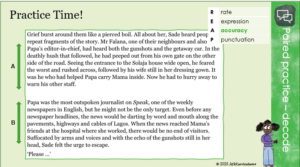
What does this look like in practice?
In English Mastery lessons, pupils develop accuracy and automaticity of words in context through paired repeated reading. The text is divided into sections and paired pupils take turn to read to aloud to a parter:
Leadership prompts:
- Check that repeated reading is built into lessons
- Ensure all pupils read aloud regularly
- Support teachers to give specific feedback on accuracy and phrasing
3. Hear a model of fluent reading and learn how to emulate it
“Read with expression” is often said. It is rarely taught.
Prosody improves when teachers model it deliberately and explain their choices. Effective modelling includes:
- Reading sections of text aloud fluently
- Highlighting punctuation and sentence structure
- Explaining why pauses, emphasis or changes in tone clarify meaning
Expression is not performance. It is comprehension made audible.
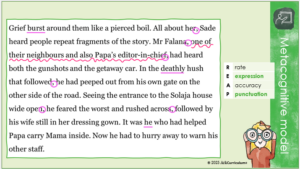
What does this look like in practice?
In English Mastery lessons, the teacher models expert reading alongside a metacognitive commentary, explaining the thinking that informs their expressive choices:
Leadership prompts:
- Include modelling of fluent reading in CPD
- Encourage teachers to verbalise why they read a passage a certain way
- Listen for consistent expectations around prosody across classrooms
Fluency sits at the centre
For leaders shaping reading provision, fluency sits at the centre of the journey from decoding to comprehension.
When pupils read fluently, working memory is freed for meaning. Confidence grows, comprehension deepens and pupils are far more likely to read independently and widely.
Reading for pleasure and reading proficiency reinforce each other.
As leaders, reflect during the National Year of Reading:
- Is fluency explicitly taught in every year group?
- Is rehearsal protected in lesson time?
- Is modelling of expression consistent across classrooms?
Fluency should not be left to chance. When it is planned and prioritised, pupils read more confidently, understand more deeply, and are far more likely to choose books independently and read for pleasure.
To see these strategies in action, explore our 3 free reading lessons, which show how to build accuracy, automaticity, and expression in the classroom.
For further support, Ark Curriculum Plus and English Mastery provide curriculum programmes and implementation support to help schools and trusts embed evidence-informed reading practice at scale. We would be delighted to talk.




Get in touch
Let us know you’re interested by completing this form. Our team will be in touch to arrange an informal meeting to discuss your school’s needs.