
By Will Power, Head of Primary Maths, Ark Curriculum Plus
Securing the foundations has always been a key component to success in maths and it is welcome that recent policy changes (Ofsted, 2025; Curriculum and Assessment Review, 2025) have returned to this theme as key to improving outcomes.
Leaders must ensure that teaching sequences, intervention strategies and staff training are aligned to this goal. By doing so, leaders create the conditions for sustainable improvement, support staff to teach with clarity and coherence, and ensure pupils are well prepared to access the full breadth of the maths curriculum with confidence.
This focus on strong foundations, and the role of leadership in securing them, is reflected clearly in recent policy:
Without secure foundations in number, pupils are restricted in their ability to reason in everyday contexts. Curriculum and Assessment Review (2025)
Inspectors must evaluate how effectively pupils are enabled to secure strong foundations to access the curriculum. Ofsted (2025)
Just like a house should be built on strong foundations, it is vital that learning builds on deep knowledge that is secure and retained. In maths, this is especially important, because if certain ‘bricks’ in the foundations are missing, it is impossible to successfully move on to more complex maths that rely on that knowledge.
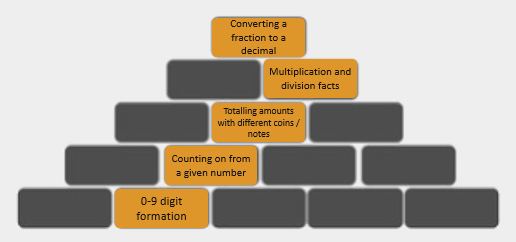
[Image credit: Jonathan Howlett, 2025]
What is foundational knowledge?
Foundational knowledge is the knowledge that it is most important for a pupil to know to be successful. It is the knowledge that opens the door for pupils to access more complex knowledge later. In primary, a lot of knowledge is foundational because it is the start of a pupil’s learning journey. Examples of foundational knowledge in maths include:
- Knowing the value of a number (cardinality)
- Knowing how numbers can be ordered in a sequence (ordinality)
- Knowing number facts and their fact families (e.g. 7+8=15; 8+7=15; 15-7=8; 15-8=7)
- Knowing multiplication and division facts and their fact families (e.g. 7×8=56; 8×7=56; 56÷7=8; 56÷8=7)
Even within categories of foundational knowledge there is ‘even more’ foundational knowledge, for example knowing 6×4=24 is much more useful than knowing 6×0=0, due to the frequency of that fact occurring in a pupil’s mathematical life.
Foundational knowledge is so important that it must be taught exceptionally well and practised over and over again to ensure it is deeply learnt and can be recalled automatically. The first round of Ofsted reports using the new framework show that inspectors are keen see evidence of this in their inspections.
Securing foundational knowledge is particularly pertinent for disadvantaged students where we see how insecure knowledge holds them back as they progress through school. For more information on this and tips for schools see the recently published Inclusion-First Curriculum Guide.
How should leaders ensure they have a robust offer for supporting foundational knowledge in maths?
1. Embed systems for teacher subject knowledge development
It is important that teachers have a clear understanding of the foundational knowledge in their phase/ year group. For leaders this means ensuring that systems for teacher subject knowledge development are in place and that they support teachers to identify foundational knowledge. A strong curriculum offer that signposts foundational knowledge is a good basis for this, alongside regular opportunities for peer support and senior leadership coaching and mentoring, for example via a co-planning structure. Teachers need to be absolutely clear what knowledge is ‘non-negotiable’ for pupils to have before they leave their class before they can think about the best ways to teach this knowledge. This works really well in reading, where it is understood that all pupils need to have secure phonic knowledge by the end of Key Stage 1. This level of rigour should apply to all areas of foundational knowledge, including in maths
2. Plan and deliver the best methods for teaching foundational knowledge
Once teachers know what knowledge is foundational, they need to know how to ensure it is taught well so it is retained. The best curricula will ensure that foundational knowledge is highlighted and lessons planned to teach using the most impactful resources. At Mathematics Mastery Primary our unit narratives are designed to highlight where foundational knowledge is introduced and it is given privileged time in the curriculum sequence to ensure it can be taught well. Other resources such as Fact Foundations for Multiplication and Division are developed within our programme to support specific foundational knowledge, in this case times tables. More generally, leaders should ask whether their offer in maths sufficiently scaffolds foundational knowledge development, both in the way this knowledge is taught and prioritised in the school timetable.
3. Ensure monitoring and assessment identifies gaps
Does your assessment system give you the information needed to identify which pupils have or do not have strong foundational knowledge? Many assessment systems provide a sweep of data to teachers and leaders, but not all surface the key information needed to identify whether pupils are secure in foundational knowledge. For example, knowing that pupils cannot solve a long division question doesn’t necessarily diagnose the real gap in knowledge: whether it is insecure division facts or simply that they struggle to apply the procedures needed to complete the long division algorithm. Often it is the former, which won’t simply be resolved by completing ‘more long division questions’. Schools are now introducing informal checks for things like number facts at the end of Y2/ start of Y3 to spot any gaps before pupils move to the next phase. Others are rechecking pupils in Y5 to ensure that times tables knowledge is secure with an emphasis on division facts, that are not tested as part of the multiplication tables check (MTC).
As leaders, our task is clear: if we want pupils to thrive in maths, we must ensure the fact foundations beneath every classroom are strong, consistent and uncompromising. By equipping teachers with deep subject knowledge, prioritising high-quality approaches to teaching foundational facts, and using assessment systems that genuinely illuminate gaps, we create the conditions for long-term mathematical success. Now is the moment to review your school’s offer: tighten what is strong, strengthen what is loose, and place foundational knowledge at the heart of your maths strategy so every pupil can build securely towards the complex learning ahead.
Watch our webinar Foundational knowledge in primary maths – how it looks and why it matters.




Get in touch
Let us know you’re interested by completing this form. Our team will be in touch to arrange an informal meeting to discuss your school’s needs.