
Jessica Wood, Head of Subject for Science at Ark Curriculum Plus shares some of the thinking behind a new approach to scaffolding for Science Mastery.
In science teaching, we often talk about the importance of modelling expert thinking. Supporting students to think scientifically is a shared priority across schools. Yet even with strong modelling, many learners struggle to internalise disciplinary processes. This blog explores how Ark Curriculum Plus is responding to that challenge through a new scaffolding approach within the Science Mastery Secondary programme to ensure inclusive science teaching.
Disciplinary scaffolds are structured resources designed to support students as they acquire the disciplinary knowledge of science (the skills that underpin scientific skills). These are not the facts and concepts (substantive knowledge) that we teach through our curriculum, but the processes: how to interpret a graph, evaluate a method or apply an equation. These are the disciplinary processes that underpin scientific expertise, which students need explicit support to master.
The Problems We’re Solving
Too often, we assume that students will pick up disciplinary knowledge through exposure. We model, we explain, we practise, but without explicit support, many students fail to retain the structure of the skill.
When I first started teaching, I noticed that pupils might complete a Punnett square successfully in one lesson but be unable to replicate the process a week later. The mental model hadn’t stuck.
This is particularly true for students with SEND or EAL, but it’s not limited to them. All students benefit from having the structure of a skill made visible. Disciplinary scaffolds do just that. They externalise the expert thinking that sits behind a task, allowing students to practise with confidence and gradually internalise the process.
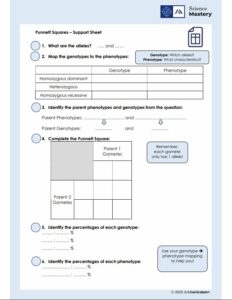
An example Support Sheet
Part of the issue here is teacher expertise; teachers are so confident with the skills (having internalised them a long time ago), that they fail to make their thinking visible to pupils. A good example of this is evaluating ideas in science; students do not understand the key words and the structure needed to be successful and so give surface-level answers.
We chose this approach because the EEF includes written scaffolds as part of their “Five-A-Day” approach to supporting students with SEND and they form part of our adaptive teaching strategies. The approach also supports students with metacognition, a strategy with strong evidence of improving attainment.
Why Disciplinary Knowledge Matters
Improving the outcomes for all pupils is part of the DNA of Ark Curriculum Plus, built into the design principles of all of our programmes and at the heart of what we do. Disciplinary scaffolds speak particularly to our principles that curricula should be responsive to the needs of our students and inclusive. These Science scaffolding strategies are another piece of the puzzle; supporting teachers using the programme to carefully plan to meet the requirements of each student.
It has been a while since Michael Young coined the term “Powerful Knowledge”, referring to information that is specialised, transferable and enables students to think in ways that open up the subject discipline. In line with the principles of powerful knowledge, disciplinary scaffolds help all students access the specialised ways of thinking that define science as a subject. They make the invisible visible, supporting equity and long-term mastery of the subject.
The explicit and precise teaching of disciplinary knowledge is what sets apart a “knowledge rich” curriculum, such as Science Mastery, from one that simply teaches pupils to recall a series of facts. Disciplinary scaffolds form our approach within Science Mastery to support departments to do this in a consistent and rigorous manner, ensuring that we are using adaptive teaching approaches to support all learners, but particularly those with SEND or EAL to ensure we are delivering inclusive science teaching.
Types of Science Scaffolds
We have created three main types of scaffolds:
- Support Sheets: These offer the highest level of scaffolding. Each step is laid out clearly, often with prompts or tips, making them ideal for first attempts at a new skill
- Structure Strips: Designed to be glued into exercise books, these act as a visual guide for writing tasks. They help students understand what to include and how much to write.
- Checklists: Familiar to most teachers, these provide a simple list of success criteria. They’re useful for peer or self-assessment and for building metacognitive skills.
These scaffolds can be general (used across multiple topics, like “Mastering Equations” or “Evaluating An Idea”) or specific (linked to a particular topic, like Punnett squares or moles calculations).
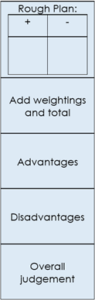
An example Structure Strip (for evaluating an idea)
Implementing Scaffolds in the Classroom
Disciplinary scaffolds are not a replacement for modelling or exposition. They work best alongside the “I, We, You” approach we have embedded in many of our resources. They’re flexible tools, and teachers are encouraged to adapt them to suit the task at hand. For example, you might remove references to variables in a practical that doesn’t involve them or simplify a scaffold for early use.
Importantly, scaffolds should be removed over time. Just as scaffolding is taken down once a building is stable, disciplinary scaffolds should be phased out as students gain confidence. This might mean switching from a support sheet to a checklist or encouraging students to use the scaffold only when needed. The end goal is independence.
A Practical Example: Punnett Squares
Consider a lesson on genetic crosses. The expert teacher knows how to convert between genotype and phenotype, draw and complete a Punnett square and calculate percentages. But for students, this is a complex process with multiple steps. A support sheet breaks it down, guiding them through each stage. Once they’ve practised a few times, a structure strip can serve as a visual reminder. Eventually, a checklist helps them self-assess their work.
This progression builds confidence and resilience. Students begin to internalise the mental model and apply it independently. Furthermore, they do not develop an overreliance on a particular scaffold because the design supports phased removal and independence.
Access a free programme preview to download the Punnett Squares disciplinary scaffolds.
Final Thoughts
Disciplinary scaffolds are not just for students who struggle. They’re for all learners, helping to make expert thinking visible and accessible. They support adaptive teaching, promote metacognition and build long-term resilience. Most importantly, they help students become successful scientists; not just in the classroom, but beyond.
If you’re interested in exploring disciplinary scaffolds further, or have ideas for new ones, we’d love to hear from you. You can read more about Science Mastery and get in touch with us.
References
- Education Endowment Foundation (EEF). The Five-a-Day Approach: How the EEF Can Support.
- Education Endowment Foundation (EEF). Metacognition and Self-Regulated Learning: Guidance Report.
- Young, M. (2013). Powerful Knowledge: What It Means for Students and Teaching.




Get in touch
Let us know you’re interested by completing this form. Our team will be in touch to arrange an informal meeting to discuss your school’s needs.