
Jessica Wood and Georgie Pick are both experienced former Science HoDs. Here they share key strategies that Heads of Science should be considering as they prepare their students for the upcoming exams.
The GCSE exam period is a stressful one for science teachers; there is so much to consider to ensure that the period goes smoothly. I always felt that I was the allegorical swan; trying to appear serene and confident while manically keeping on top of the revision and intervention preparation that is inevitable at this time of year. Here are 5 important tips to ensure that you make the most of this period.
- Map out the key dates week-by-week so you know what to focus on. These will include the exam dates but also milestones such as the last date for tiering decisions (your exams officer might have their own internal date for this), last day of teaching if your pupils have study leave and any leavers day events the school is putting on for your students. This will show you how many lessons are left to deliver key revision lessons.
- Identify a manageable-sized group for extra support. In some schools I visit, teachers are expected to host large numbers of students for after school intervention sessions. While this can be helpful, this often leads to a lack of focus on the valuable time that is available in timetabled lessons. Based on your school’s priorities, identify around 10% of the cohort for whom improved grades have a big impact. Consider students who are underperforming relative to their target who are likely to benefit from your support; for instance, pupils with very poor attendance may not be the biggest lever for improvement. Highlight these pupils to classroom teachers and support teachers to intervene with these pupils in lessons. For example, do these pupils struggle with a particular skill or do they always fail to hand in revision homework? Moving the needle in the 5+ hours a week they have in lesson will have a much bigger impact than one or two hours after school.
- Ensure students are working hard in lessons. When I visit schools during exam season, Year 11s are often sat listening to teachers rattle through key facts about a topic. This feels reassuring for teachers and students alike; teachers think “I told them about X so now they know it” and pupils feel happy that the teachers have covered a unit. However, we know that very little information is retained with this instructional style. I’d recommend creating a revision lesson template for your teachers which foregrounds the useful revision strategies. For example, get pupils to complete a knowledge quiz on a topic they are struggling with, then model how to answer a relevant exam question before asking pupils to complete exam questions independently. This is also a great opportunity to model to students how to use exam mark schemes, further building their independent revision skills. For our Science Mastery partner schools, I always recommend using the resources from previous lessons because these use teaching and learning strategies that research shows us are effective in securing knowledge for pupils long-term.
- Use data to identify topics to work on. I would always suggest that schools use topic-level analysis from mock exams to decide which specific areas to focus on. For example, Science Mastery schools have access to Smart Grade to dig down into the topics that their classes have scored poorly on. You can then add this information to your revision map:
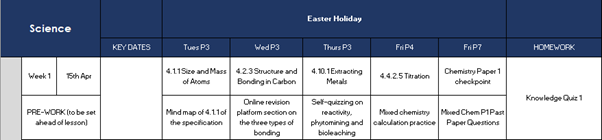 The more granular here the better; don’t just specify the topic but consider what parts are most relevant for pupils. Required practicals are really important to include as any particular one has a good chance of being included in exams and being worth a significant proportion of the marks.
- Make it easy for pupils to revise independently by providing clear sets of resources in the form of a checklist they can work through. It is key not to overwhelm pupils as this can lead to them switching off entirely. Provide a range of activities that you know are effective (quizzing, elaboration, exam-style questions) and give them a timeline to complete this.
Looking for a new approach to science lessons? Learn more about our subject excellence programme for 11-16.



Get in touch
Let us know you’re interested by completing this form. Our team will be in touch to arrange an informal meeting to discuss your school’s needs.