
Penguins don’t just live in colonies so they can huddle together for warmth; they do it because they understand the power of community. By sharing the same space, they can work together, learn from each other and adapt their behaviours for the good of everyone in the group.
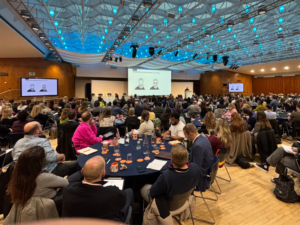
Educators are a lot like penguins. That’s why we brought together over 300 teachers and school leaders from across the country for the Ark Curriculum Plus (AC+) conference on an icy January day. By gathering in one place, we facilitated celebration, connection and collaboration.
Even though sessions were varied, with English, maths, geography and science teams delivering sessions relevant to their subjects, some common themes emerged from the day which are useful to consider.
Effective implementation
The theme of the whole event was “Impact through Implementation”. The day began with Madeleine Anderson, Managing Director of AC+, welcoming delegates and inviting them to engage and network throughout the day. Madeleine explained that the conference would very intentionally not be considering the theory of what could come from curriculum reform. That’s because: “implementation of best practice and strong subject pedagogies is more important for school and learner success.”
As teachers, we’ve nearly all been through curriculum changes before – what matters most is having the core subject knowledge and confidence to deliver brilliant lessons, whatever comes from the curriculum reform.
In several subject sessions on implementation, it was evident that the professional development is the crucial factor for success. Alongside this, teachers several years into their AC+ journey reflected that Mastery Leads should be prepared to tailor the implementation of the programme to meet the context of their school, supported by their AC+ Development Lead. The plan to launch a programme should consider teachers’ experience and receptiveness to change and align with the school’s strategic focus – it’s not a one-size-fits-all. As Nicholas Starling, Assistant Head Teacher at Mile Cross Primary, Norwich said: “It’s not a scheme of work; it’s a professional development programme. It’s about teachers realising the programme is upskilling them, that they’re going to be better teachers.”
There were also plenty of moments taken to celebrate the success of schools, like Mile Cross, who have been on that journey and have achieved success. It’s so worth it – that’s why Nicholas, and the many other partner schools who contributed during the event, are so willing to share their experiences to help others.
Metacognition and modelling
From the keynote and across several sessions, the “how” of “Impact through Implementation” leaned into metacognition and deliberate teacher modelling.
Oliver Caviglioli kicked us off with some useful insights in his keynote. Focusing on cognitive load theory and metacognition, he highlighted how, despite the extensive research in the area, the fundamentals are usually things we’re already aware of and probably already doing in our classrooms. He considers cognitive load theory “less a science to follow and more a heuristic – a rule of thumb, something ‘generally so’ that’s useful to bear in mind.” For example, teachers are used to ensuring that learning content in a lesson is not:
- Too fast
- Too much
- Too new
- Too complicated
- Too fleeting
He outlined how writing is a key part of the metacognitive loop: Writing something down, looking at your thoughts, then changing your thoughts and writing them down, is all part of the process. Teachers do that when they model their thinking, making their thoughts visible and concrete.
Oliver also provided some handy tips to help reduce cognitive load in lesson materials:
- Avoid using the Comic Sans type face
- Don’t centre text
- Make sure a line has max 55 characters (including spaces)
In a panel discussion on developing students’ spoken language ability in English, the participants noted that as teachers quite used to modelling writing, they should also be deliberately modelling speaking for students.
Metacognition was taken to another level in Dr Sarah Dowey’s session for senior leaders looking at practising metacognition as part of co-planning. Taking a metacognitive approach as part of the intellectual preparation for lessons, means that teachers will be better equipped to model their thinking for learners.
Rosie Lloyd and Georgie Pick took a deep dive into the I-We-You model for science – a simple model of classroom instruction which provides a gradual transfer of responsibility from the teacher to the student. There was a consensus that most teachers struggled with the We do part. The AC+ team have noticed across the schools they visit that typically this is because either the teachers didn’t do the I do part effectively enough by not describing their thinking in full and showing all the steps, or the We do was almost a repeat of the I do.
These sessions reiterated that truly effective implementation relies on teachers developing their own knowledge, skills and confidence, so that they are ready to deliberately model their thinking, helping students to build metacognitive skills. Something that can be done with subject specific CPD, expert support, dedicated time for co-planning and, of course, classroom practice!
Wrapping up
This was just the tip of the iceberg in terms of all the amazing experiences, ideas and advice that were shared at the conference. Like penguins, we always seek ways to bring passionate leaders and teachers together – the connections go beyond this day, the ideas shared will be applied in classrooms across the country, and we will always take time to celebrate our community’s successes.
Join us on social media for more connecting and sharing:
We’re already excited for next year! In the meantime, the AC+ team will continue working with partner schools to put into practice the best tools and strategies for their unique context. By supporting that effective implementation, together we can achieve positive impact.




Get in touch
Let us know you’re interested by completing this form. Our team will be in touch to arrange an informal meeting to discuss your school’s needs.