
School information
School type: Academy (part of Lincolnshire Gateway Academies Trust)
Local authority: Lincolnshire
Age range: 11–16
Pupils: 864
FSM: 40.5%
EAL: 3.0%
Joined English Mastery Secondary: 2023
School context
Louth Academy has undergone an extraordinary transformation, evolving from the merger of two struggling schools with a combined Progress 8 score close to -1 into the highest-achieving school in East Lindsey. Today, the academy proudly boasts a Progress 8 score of +0.43 overall, with exceptional outcomes for all groups – including +0.33 for SEND students and a positive score for disadvantaged learners.
This remarkable turnaround has earned Louth Academy recognition at a regional DfE event, where it was invited to present on raising attainment for white working-class students. Their effective use of the English Mastery programme has been part of this journey.
Why choose English Mastery?
Before joining the programme, the school identified that the quality of education and curriculum at the lower school lacked the high standards and rigor of the upper school, and this did not adequately prepare students for success.
With the support of the principal, the school joined the two-year English Mastery randomised controlled trial run by the Education Endowment Foundation. They were selected as a treatment school so began delivering the English Mastery Secondary programme in September 2023. The trial ended in July 2025 and the school chose to continue with the programme from September 2025.
Through their use of the programme, the school’s goal was to improve curriculum rigour, enhance teaching quality and address persistent issues in spelling, punctuation and grammar (SPaG) across subjects.
Impact in English and beyond
When asked to reflect on one aspect of the programme that has made a significant impact, Catherine Brett, Head of English at Louth Academy, highlighted Mastery Checks. A core part of the programme; Mastery Checks are used to assess accuracy on writing tasks in both Writing Mastery and Literary Heritage lessons. This helps to consolidate grammar knowledge and writing accuracy across the curriculum and keep expectations high. (Example below.)
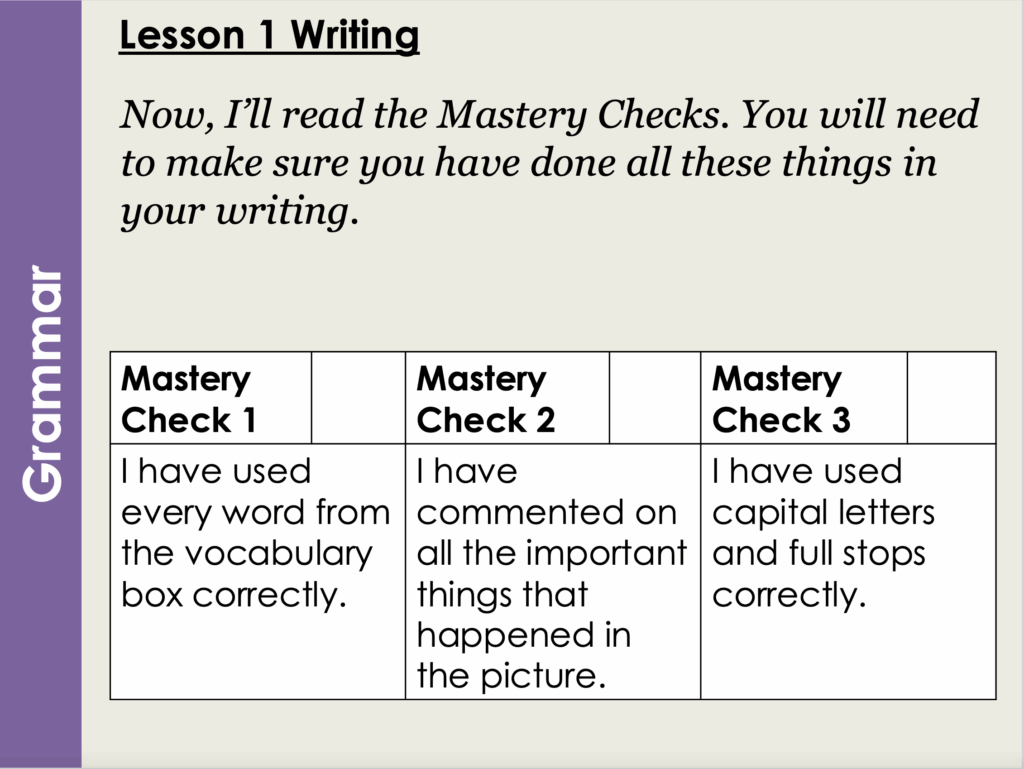
By implementing these checks, the school replaced a passive feedback model with actionable routines that encouraged independent correction and habitual engagement with SPaG.
Following a successful roll out in English, the strategy was expanded across the academy in a whole-staff CPD session, prioritising three commonly occurring errors: capitalisation, key spellings and apostrophes.
The session introduced the rationale for Mastery Checks, showed how to use them and set expectations for use in all lessons involving extended writing. While staff were generally receptive, targeted support was offered to those less confident, including opportunities to observe Mastery Checks during English lessons.
“The increased focus on SPaG led to improved student engagement and a notable improvement in GCSE outcomes.” – Catherine Brett, Head of English, Louth Academy
Book looks and curriculum feedback demonstrated students were proactively checking SPaG by engaging with the Mastery Checks and this resulted in improvements at GCSE. There were some inconsistencies in staff application which prompted Catherine to introduce further coaching and a revised approach: focusing on one Mastery Check per term.
Leadership development
Catherine Brett also explained how English Mastery has been a catalyst for her own leadership growth. She participated in the regular CPD opportunities available within the programme to support subject leaders.
“The programme has strengthened my personal leadership; allowing me to elevate standards, refine pedagogical approaches, and design a curriculum we are proud to offer.” – Catherine Brett, Head of English, Louth Academy
Catherine developed a collaborative culture in the English Department through weekly co-planning meetings, targeted CPD and peer-led coaching, with the support and guidance of the dedicated AC+ subject expert.
Working together helped to establish clear areas of focus. For example, they identified that teachers with primary school experience excelled in teaching grammar. By asking teachers to deliver short CPD sessions in their areas of expertise, they enhanced departmental knowledge, empowered them as CPD facilitators and established experts within the team.
The emphasis on oracy through ‘Turn and talk’ tasks was identified as a pedagogical bright spot – this has also been adopted as a school-wide initiative.
The English department’s success led to staff from other departments and across the trust being invited to observe English Mastery lessons.
The journey so far has not only improved student outcomes but also fostered “a culture of collaboration, accountability and motivation”, according to the principal. The school is now embedding English Mastery in Year 9 and Catherine is launching a buddy coaching system to ensure all colleagues thrive in their roles.
It’s working
Joe Hermiston, Academy Principal, highlighted the effects observed after just two years on the programme:
“English Mastery has completely revolutionised the teaching and pedagogical approach in the faculty. It has been truly transformative for our students.”
A beacon for success
Further cementing its reputation for excellence, the academy has been designated an English Mastery Ambassador School and welcomed over 100 visitors in the past year eager to learn from its best practice. Louth Academy’s journey stands as a testament to the power of strong leadership, dedicated staff, and a relentless commitment to student success.

More case studies

Using Smartgrade to support responsive teaching and inclusion in science

Beyond resources: The support behind successful implementation

A joined-up approach to teaching and learning

Get in touch
Let us know you’re interested by completing this form. Our team will be in touch to arrange an informal meeting to discuss your school’s needs.